Sri Lanka
 USA
USA Canada
 India
India UK
UK UAE
UAE




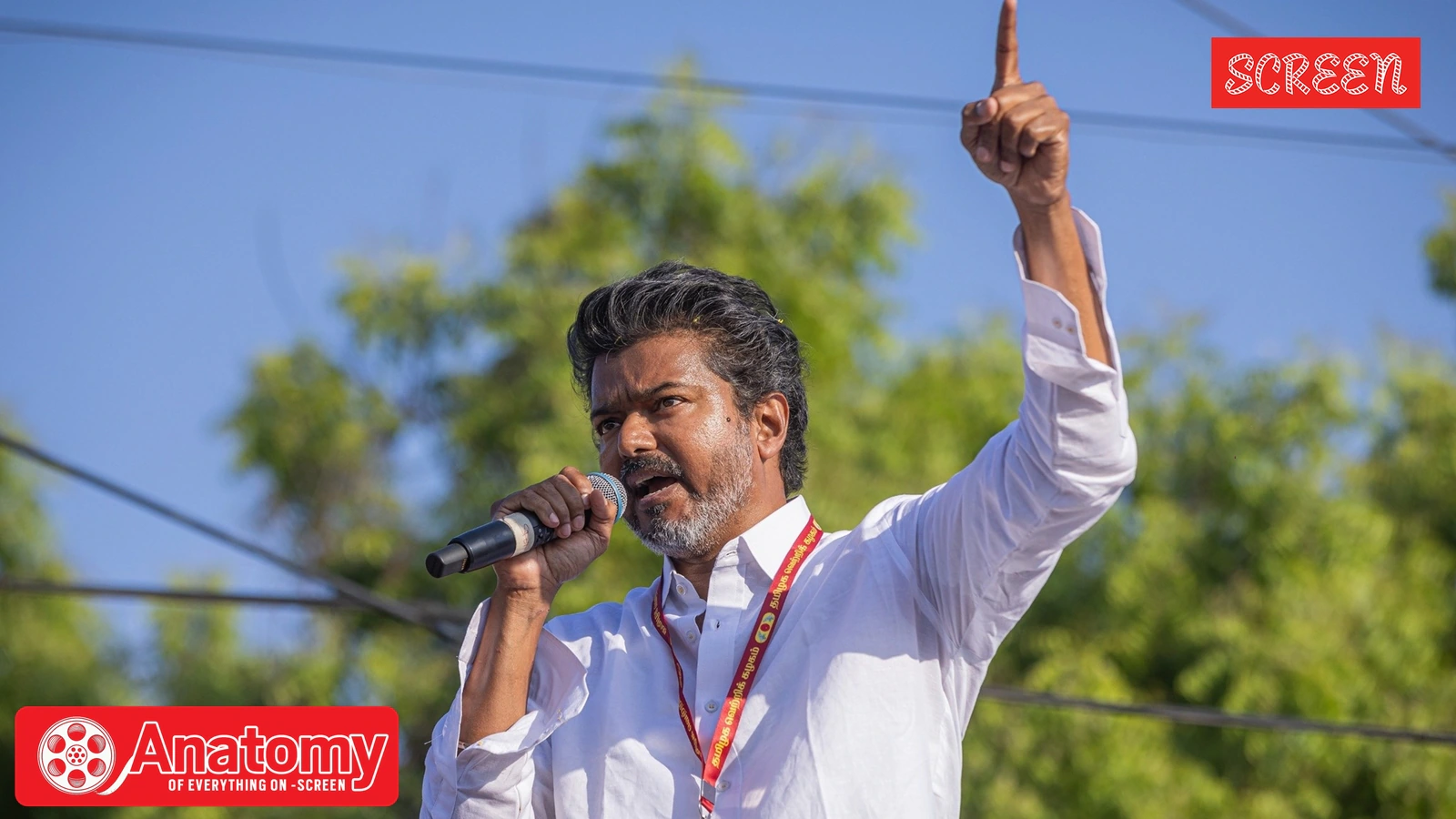
Following TVK’s 2026 landslide victory in Tamil Nadu, Sandeep Reddy Vanga praised Vijay’s cinematic power. A look at how CM Vijay’s filmography shaped his political image.
Following Vijay and Tamilaga Vettri Kazhagam’s sweeping victory in the 2026 Tamil Nadu Assembly elections, controversial filmmaker Sandeep Reddy Vanga shared a congratulatory message on social media, describing the result as proof of cinema’s extraordinary influence on society.
He wrote that cinema has the power to “move people, shake systems, and turn presence into power,” highlighting how Vijay’s transition from film star to political leader reflected the deep connection between screen image and public influence.
However, the statement also reignited long-standing debates raised by Vanga’s critics, who have frequently argued that films can significantly shape public thinking and behaviour. Over the years, there have been several cases where individuals were reportedly influenced by movies or series, sometimes leading to criminal acts or social tensions.
Critics also point out that cinema can contribute to the spread of misinformation, selective narratives, or social divisions, occasionally creating friction between communities and, in some cases, escalating into violence.
Yet, filmmakers have never taken responsibility for the real-life consequences of the depictions in their works. They simply argue that “cinema is just cinema,” and their fans quickly join the chorus. However, Vijay’s victory, as well as Sandeep Reddy Vanga’s tweet, conclusively prove that cinema can have a far-reaching influence on the masses and even help someone become the Chief Minister of a state, disrupting decades-old political equations.
Vijay and MGR
While many compare him to MG Ramachandran, the legendary actor and former Chief Minister of Tamil Nadu, Vijay may have proven himself to be an even bigger force than MGR. Although MGR became CM only in 1977, he had been active in politics since the 1950s. By the time he launched his All India Anna Dravida Munnetra Kazhagam (AIADMK) in 1972, he had gained nearly two decades of experience working with the Dravida Munnetra Kazhagam (DMK) and had served as an MLC and an MLA. Also, AIADMK faced its first Assembly polls in 1977, five years after its formation.
Now, consider Vijay’s case. Not only was he not part of any political outfit prior to this, but he faced his first Assembly elections just two years after TVK’s formation. Yet, about 34.92 per cent of the citizens who exercised their franchise this time in Tamil Nadu placed absolute faith in Vijay and TVK. They trust Vijay to be the alternative they have been looking for, or so it seems, although he has yet to demonstrate his potential as an administrator in any substantial way.
Vijay’s star campaigner
So how did he win? The answer is simple and quite obvious. It’s there in Sandeep Reddy Vanga’s tweet, and one can trace the same thing in MGR’s career as well — cinema! While Tamil cinema’s liaison with politics is well-established and widely popular, MGR can undoubtedly be described as one of its biggest beneficiaries, albeit not the only one. Ever since his career took off with Rajakumari (1947), MGR placed significant importance on doing political movies. Even if not all of them were outright mouthpieces for Dravidian or DMK ideologies, most had political undertones in one way or another, which collectively contributed to establishing MGR’s image as the saviour of the downtrodden.
A simple look at the movies Vijay has done over the years and their politics — both on the surface level and deep within — would lay bare why the masses have placed such immense trust in him, as well as underscore the power of movies. In fact, it would even make one wonder if Vijay’s filmography was more or less carefully curated to build a particular public image for him.
The ‘Vijay brand’
However, whether it was or wasn’t, the ‘Vijay brand’ isn’t a homogeneous one he built by doing the exact same roles. Instead, he un/knowingly ensured that he meant different things to different people, yet all had nothing but love for him. At the same time, the image was also carefully engineered to satisfy the patriarchal expectations of the “complete man,” which, unfortunately, has an immense fan base among women, too.
Although his debut film, Naalaiya Theerpu (1992), directed by his father SA Chandrasekhar and produced by his mother Shoba Chandrasekhar, did not perform well at the box office, a close observation of the film now reveals that even this movie might have actually tried to sell a particular image of the actor. At one point, an enraged Vijay tells his friends, “The elders often say that the future of this country is in the hands of youngsters like us. But they won’t hand it over to us. The time has come for us to (forcibly) take it.” Three decades later, isn’t that pretty much what he has done? Even though he is in his 50s now, there’s no denying he had youth on his side.
While Naalaiya Theerpu drew on the soul of Ram Gopal Varma’s Shiva (1989), Vijay wasn’t just the “angry young man” in it. He wasn’t a lone wolf; he smiled, joked around with his friends, and fell in love freely. Beyond everything, he was extremely close to his mother (Srividya), a sentiment that Indian audiences can never overlook.
The romantic Vijay
Going forward, he realised that it was best to focus on young audiences — particularly children, teenagers, and young adults — and his movies predominantly catered to that base. Along with the “angry young man” image, Vijay also positioned himself as the romantic hero. Movies like Rasigan (1994), Poove Unakkaga (1996), Nerrukku Ner (1997), Kadhalukku Mariyadhai (1997), Thulladha Manamum Thullum (1999), Minsara Kanna (1999), Kushi (2000), and Friends (2001) utilised both images accordingly. He thus became the poster boy for romance in Tamil cinema, who killed it in the dance numbers.
Vijay: The saviour
Gradually, the number of people Vijay would have to rescue during a movie’s runtime increased. As if he had an immense saviour complex, quite a few of his subsequent films had him appearing as different versions of a messiah. What made these characters resonate with the audience, nonetheless, was that they all hailed from noble backgrounds, making the masses believe that he was one of them and/or that a saviour could very well emerge from among them.
In movies like Pokkiri (2007), Kuruvi (2008), Vettaikaaran (2009), Sura (2010), and Velayudham (2011), his fight wasn’t just against the respective villains but also against the system that fostered an environment where they thrived. He positioned himself as the one who would raise his voice and fight for the rights of those denied their due.
At the same time, these films satisfied testosterone-driven male audience members by glorifying toxic masculinity and lecturing women on how to be “cultured,” arguing that if they embraced “western culture,” they instantly became “worthless.” The incel men among his fan base cheered hearing these dialogues, which they believed were sacred, while even some women accepted these notions as true and felt they needed to be “put in their place.”
In films like Thalaivaa (2013) and Kaththi (2014), he saved whole localities and communities while demonstrating what qualities a true leader should possess. What further connected these narratives to the audience were the moments when he showed vulnerability — instances when he broke down, losing all hope, much like anyone else. Have we ever seen MK Stalin in such moments? Or any other politicians? But with Vijay, we have, even if not in real life.
Kaththi also marked the beginning of an era in which Vijay films focused completely on shedding light on serious societal issues. A look back would even make one wonder whether each of his movies was a point from an election manifesto. While Kaththi discussed farmers’ plights, Bairavaa (2017) showcased issues faced by students. Mersal (2017), on the other hand, addressed malpractices in the healthcare sector and the government’s role as a mute spectator while private entities fleeced commoners by denying them quality, affordable medical attention. All these films shared one common factor — a promise that Annan (elder brother) would come and save all of us!
As women’s empowerment and feminism gained more ground during this era, his films began giving women more space. In Bigil (2019), Vijay even became a coach of a women’s football team. However, the irony was that, even in a movie that purported to showcase the true potential of women, Vijay was portrayed as the supreme figure while the women were beneath him. Yet, his fans cheered, overlooking this blatant misogyny.
In Sarkar (2018), he fought electoral fraud, while in Master (2021), his battle was for children in conflict with the law who were being abused by the powerful. Even as he fought terrorism in Beast (2022), in Leo (2023), he led a battle against drugs. His last release to date, The Greatest of All Time (2024), was the most intriguing of all. At a time when M Karunanidhi’s son, MK Stalin, was ruling the state and his son, Udhayanidhi Stalin, was slowly emerging as the second-in-command, GOAT depicted how Vijay wouldn’t show any compromise, even with his closest people, if they were tainted.
‘C Joseph Vijay ennum naan…’
One could easily say these were just movies and that they wouldn’t have played a significant role in shaping a certain image of Vijay in the public’s hearts. However, we shouldn’t forget the fact that he always maintained a low profile when not involved in movies. This habit not only reinforced the notion that “he is just an ordinary person like us” among the public but also led them to believe that who they encountered on screen was the Vijay.
Since the only other time they saw him was during the audio launches of his movies, where he delivered carefully crafted speeches that further amplified his image, the common people had no other way to understand the actual Vijay. Hence, it is safe to say that his movies did the most campaigning for him.
And this phenomenon did not start just yesterday or the day before. It may have started back in 1992 with Naalaiya Theerpu, in 2002 with Thamizhan, in 2014 with Kaththi, in 2017 with Mersal, or in 2018 with Sarkar. Regardless of when it began, Vijay’s victory and rise as Tamil Nadu Chief Minister underscore the power of cinema.