Sri Lanka
 USA
USA Canada
 India
India UK
UK UAE
UAE




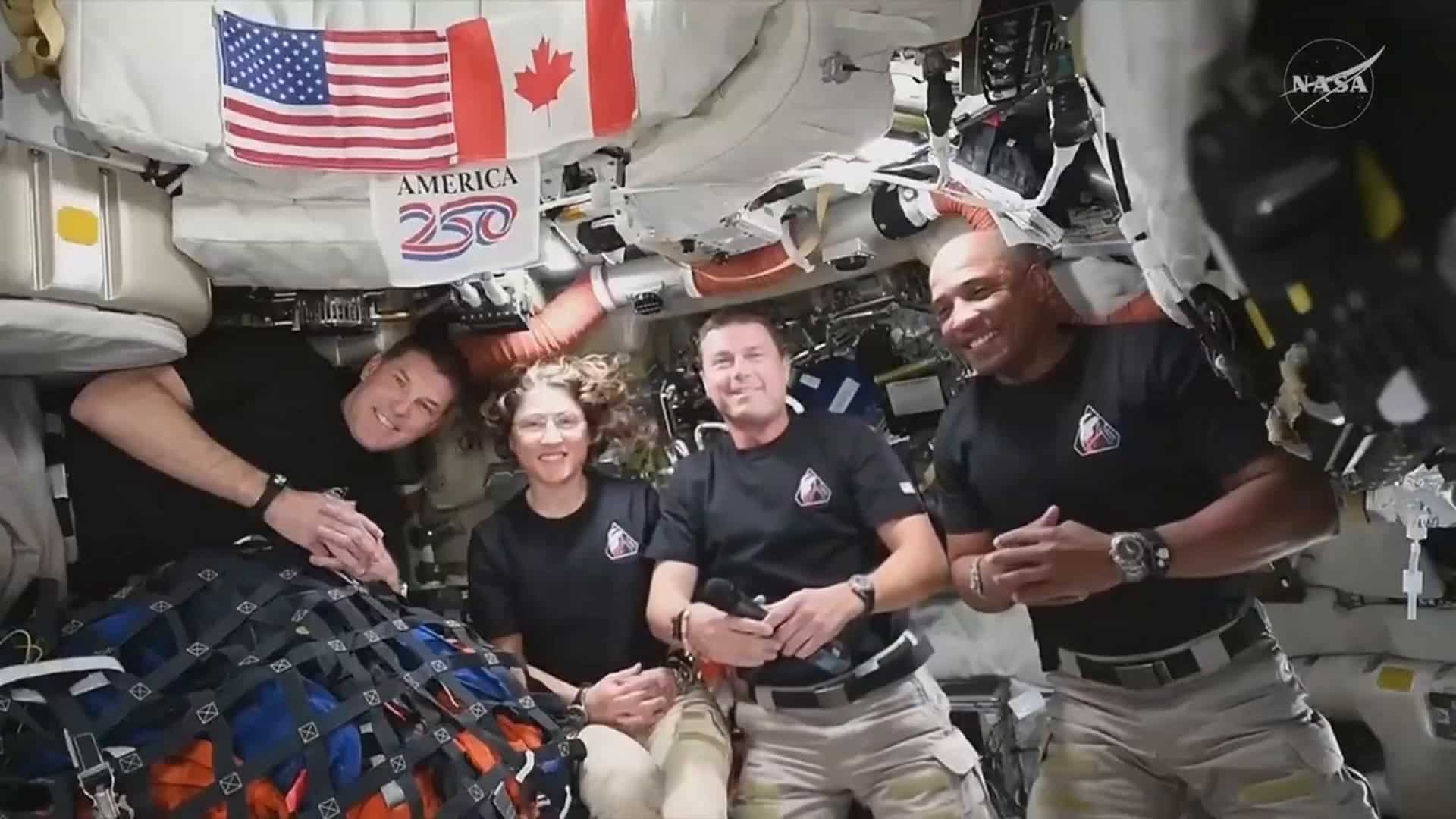
Four astronauts aboard NASA’s Artemis II mission are on their return journey to Earth after a historic lunar flyby, during which they traveled farther from our planet than any humans in history.
As expected, the crew lost communication with Earth for about 40 minutes while passing behind the Moon. When contact was restored, astronaut Christina Koch shared her relief: “It’s so great to hear the Earth again.”
During the flyby, Orion—the spacecraft carrying the crew—passed within a few thousand miles of the Moon’s surface, giving the astronauts a first-ever view of a total solar eclipse from the Moon’s perspective, as its shadow blocked the Sun.
At approximately 13:56 EDT (18:56 BST) on Monday, Artemis II set a new record for human travel at nearly 248,655 miles (400,000 km), surpassing the Apollo 13 mission’s distance record from 1970. Canadian astronaut Jeremy Hansen acknowledged the milestone, honoring the legacy of previous space explorers.
The astronauts observed and documented features on the Moon’s far side, which is never visible from Earth. They captured images, made sketches, and recorded audio notes to document their unique perspective of craters, lava plains, and previously unseen terrain.
While the mission did not include a lunar landing, the flyby offered a rare opportunity to view the Moon’s far side firsthand. West End director Paul Morrissey, who monitored the mission, described the journey as “a celebration of collaboration across cultures,” highlighting the astronauts’ historic observations.
During a conversation with President Trump following the flyby, Commander Reid Wiseman reflected on the experience: “We saw sights that no human has ever seen, not even Apollo, and that was amazing for us.” Fellow astronaut Jeremy Hansen requested that two craters be named—one “Integrity,” after their Orion capsule, and another to honor Wiseman’s late wife, Carroll, as a personal tribute.
The crew utilized high-resolution DSLR cameras with wide-angle and zoom lenses, a mirrorless camera to replicate human vision, and small video cameras mounted on Orion’s solar arrays to record continuous footage of the Moon’s surface. Astronauts also used smartphones to capture daily life inside the capsule. NASA plans to release much of the imagery and audio either during the mission or after Orion’s return.
To improve visibility during the flyby, the crew dimmed interior lights and focused on observing subtle colors, textures, and geological features on the lunar surface. NASA’s lunar science lead, Dr. Kelsey Young, explained that human eyes can detect nuances that cameras sometimes cannot, making the astronauts’ observations critical for science.
The most tense part of the mission occurred as Orion passed behind the Moon, losing radio and laser communication for roughly 40 minutes. Before the blackout, Pilot Victor Glover sent a message to Earth: “As we prepare to go out of radio communication, we’ll still feel your love from Earth. And to all of you down there on Earth and around Earth, we love you, from the Moon. We will see you on the other side.”
Once communication was restored, Christina Koch addressed mission control with an inspiring reflection on humanity’s future in space: “We will explore. We will build ships. We will visit again. We will construct science outposts. We will drive rovers, we will do radio astronomy, we will found companies, we will bolster industry, we will inspire. But ultimately, we will always choose Earth. We will always choose each other.”
The flyby also included a partial solar eclipse, revealing the Sun’s corona against the darkened lunar surface—a rare and breathtaking sight. Glover described the view: “It is amazing; the brightness where the sunset is still bright, and you still have a distinct Earth shine.”
Artemis II’s mission is a test flight designed to validate Orion’s systems in preparation for future lunar missions and, eventually, human travel to Mars. Sensors on the spacecraft monitored how its power and thermal systems coped with rapid temperature changes during the eclipse and passage behind the Moon.
As Orion begins its quieter days of experiments and system checks, the crew will prepare for the final challenge: re-entry into Earth’s atmosphere at nearly 25,000 mph, culminating in a parachute-assisted splashdown in the Pacific to test the capsule’s heat shield and recovery systems.