Sri Lanka
 USA
USA Canada
 India
India UK
UK UAE
UAE




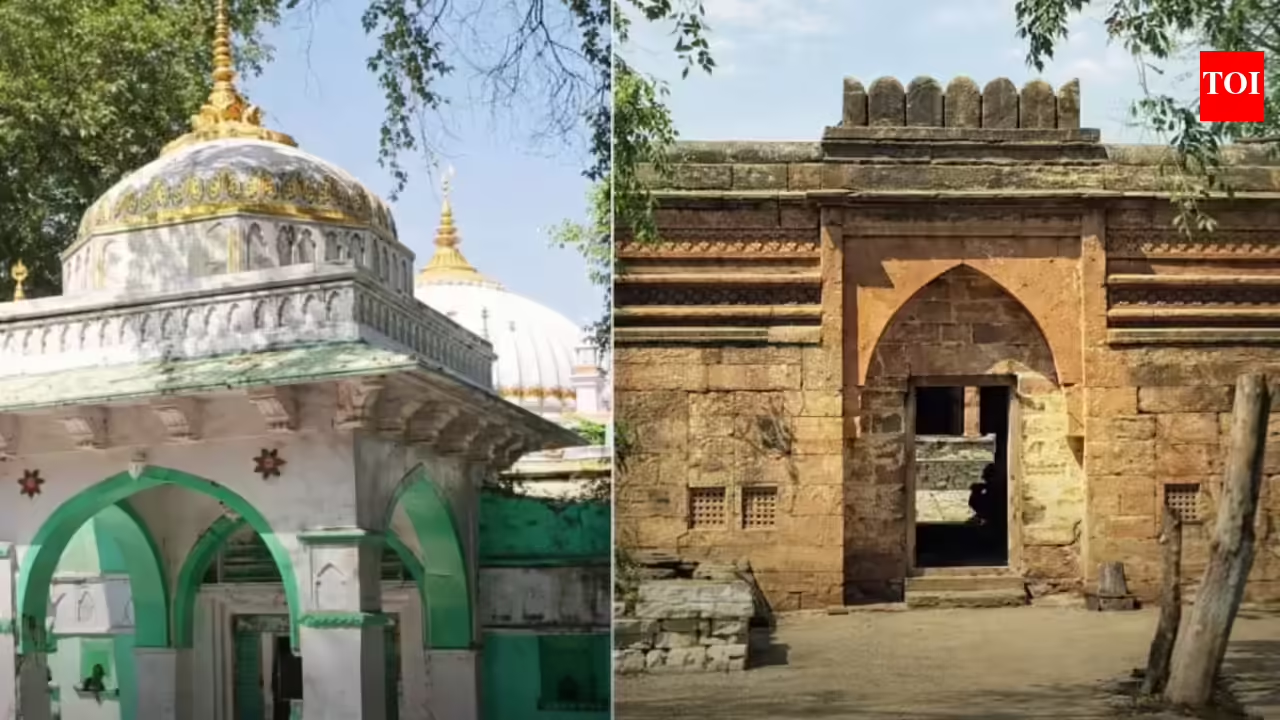
The state government stated in its response that permission granted to members of the Muslim community to offer namaz at the disputed site was intended solely to ease communal tensions and maintain public order.
The Madhya Pradesh government has reportedly told the High Court in written submissions that the disputed Bhojshala site in Dhar “was never a mosque” and that the Muslim community does not have the right to offer namaz there, according to reports by The Indian Express.
The submissions were filed on behalf of multiple respondents, including the State Government, the Dhar Archaeological Officer, the District Magistrate, and the Superintendent of Police. The matter is linked to five petitions currently before the court, which is hearing rebuttal arguments ahead of delivering its verdict.
In its response, the state government stated that permission previously granted to the Muslim community to offer namaz at the disputed site was intended only to ease communal tensions and maintain public order.
The reply further argued that the structure in question had never functioned as a mosque and therefore the Muslim community could not claim rights or ownership over the Bhojshala premises.
According to the submission, the entire site belongs to the state government and has remained under the control of the Archaeological Survey of India since before India’s independence.

The respondents have stated that since the site was “the school of the most celebrated King of Parmar Dynastry, King Bhoj” and “not a mosque”, the “question of violation of fundamental rights of the Muslim community does not arise”.
The structure “does not fulfil the essentials of a mosque,” the reply stated, adding, “It is most humbly submitted that the structure of Bhojshala as it exists today also has the visible impression of Hindu deities on it.”
Prior to 1935, there was “no regular offering of namaz, and the official correspondence of the then princely State of Dhar reveals that a very few Muslims started to offer namaz, that too irregularly at the said place”.
“In 1935, a dispute occurred between two communities, and the communal situation got out of control and, just to defuse the situation, the then princely State of Dhar allowed the Muslim community to offer prayers at the said place,” the respondents submitted.
The ASI, which submitted a separate reply in the case, stated that the “remnants of this Bhojshala or the temple of Goddess Saraswati are still seen in this monument, which was turned into a mosque by the subsequent Muslim ruler of Dhar in circa 14th century CE by using the architectural members of the pre-existing building belonging to Bhojshala.”
The respondents submitted that the orders passed by the ASI and the Collector were “with the intention to maintain communal peace in the region.”
“Considering the nature of the structure, the Director General of the Archaeological Survey of India, by order dated 07-04-2003, allowed the Hindu community to access the premises on every Tuesday from sunrise to sunset,” the respondents stated.
The petition filed by Maulana Kamaluddin stated that the Bhojshala-Kamal Maulana Masjid is “essentially a mosque”, and as per the tenets of Muslim Law, “any activity except offering namaz in the mosque is not permitted”.
The petitioner highlighted the alleged failure of the state government in “restricting the aarti and offering of puja, etc at the mosque”, which it claimed is “a gross violation of fundamental right guaranteed to Muslims under… the Constitution of India.”
According to the petitioners, the respondents are “duty-bound to ensure that no puja, aarti, etc, is held and recited at Bhojshala Kamal Maulana Masjid Dhar.”