Sri Lanka
 USA
USA Canada
 India
India UK
UK UAE
UAE




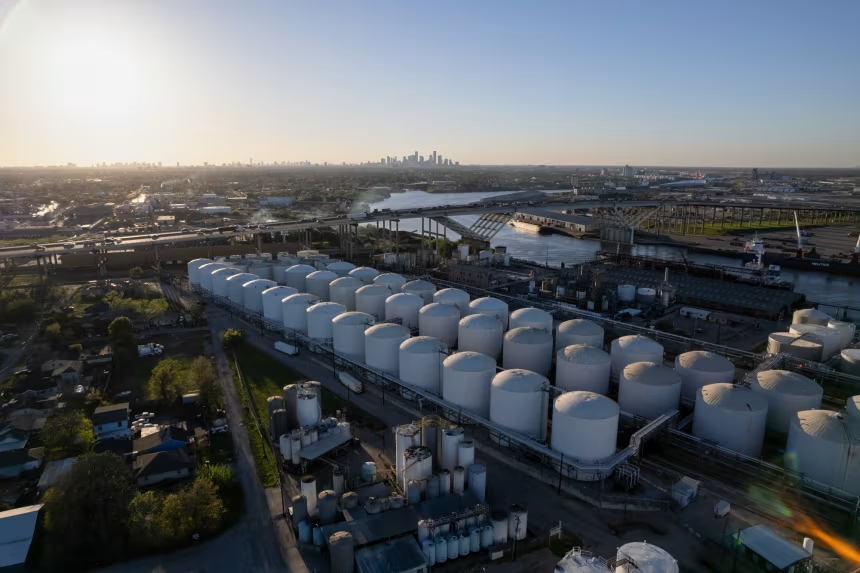
Global oil prices climbed sharply on Sunday evening, reaching their highest levels since July 2022, as tensions surrounding the ongoing war with Iran continued to disrupt global energy supplies.
Brent crude, the global oil benchmark, increased by 2.9% to approximately $106.12 per barrel, while US crude oil rose by 2.6% to $101.53 per barrel.
The surge comes as the US and Israel-led war with Iran entered its third week, triggering what analysts describe as one of the largest oil supply disruptions in history. A key factor behind the spike in prices is the effective closure of the Strait of Hormuz, a strategic waterway controlled by Iran through which nearly 20% of the world’s oil supply normally passes.
Since the start of the conflict on February 28, oil tankers have largely been unable to move through the strait, creating major concerns about global energy supply chains.
US President Donald Trump has urged the international community to assist in reopening the strait to restore oil shipments. In a post on Truth Social on Saturday, Trump called on other nations to help coordinate efforts to ensure that the flow of oil resumes “quickly, smoothly, and well.”
The Trump administration has previously stated that the United States plans to deploy naval forces to escort and protect oil tankers leaving the Middle East. However, officials recently acknowledged that it could take several weeks before the US Navy is fully prepared to carry out such operations.
Meanwhile, Iran has increased pressure in the region, reportedly laying mines in the Strait of Hormuz and warning it would target any oil and gas infrastructure linked to the United States. Several tankers have already been struck since the conflict began.
The United States has also conducted strikes on Kharg Island, which hosts the majority of Iran’s oil export infrastructure. However, US officials say Iran’s oil production facilities have largely been spared so far.
In an effort to stabilize markets and counter rising fuel prices, the US government announced several measures over the weekend to boost domestic production. A new BP offshore project in the Gulf of Mexico was approved — the company’s first major offshore development since the Deepwater Horizon disaster. In addition, Energy Secretary Chris Wright instructed Sable Offshore Corp. to restart oil rigs and pipelines off the coast of Southern California.
International efforts are also underway to ease the supply crunch. Member countries of the International Energy Agency (IEA) agreed to release 400 million barrels of emergency oil reserves, the largest coordinated release in the agency’s history. However, much of this supply is not expected to reach markets until the end of March.
Fuel prices in the United States have already begun to rise due to the disruption. According to AAA, average gasoline prices have climbed 24% to about $3.70 per gallon since the war began.
The spike in fuel costs threatens to undermine one of Trump’s key economic claims — that gasoline prices had dropped significantly during his second term. Prices had fallen below $3 per gallon in December, the lowest level since May 2021.
The disruption of the Strait of Hormuz could also affect global food prices. The waterway is a major route for fertilizer shipments used by farmers worldwide, as well as for transporting perishable goods such as dairy products, fruits, vegetables, and seafood. Prolonged disruptions could therefore push grocery prices higher in the coming weeks.