Sri Lanka
 USA
USA Canada
 India
India UK
UK UAE
UAE




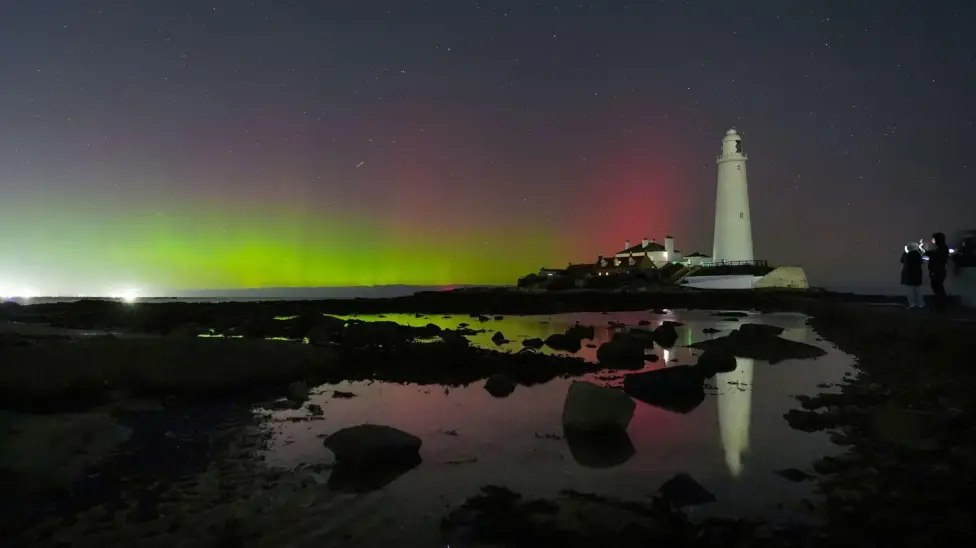
The Northern Lights could grace much of the UK this week, as scientists warn of a potential “severe” geomagnetic storm triggered by multiple solar eruptions from the Sun. The rare phenomenon may be visible as far south as Wales and the Midlands under clear night skies.
The United Kingdom is expected to witness a rare celestial spectacle this week as the Northern Lights, or Aurora Borealis, could be visible across large parts of the country due to heightened solar activity.
According to the UK Met Office Space Weather forecast, the best chance of sighting the aurora will be in the northern half of the UK, though those under clear skies further south may also catch a glimpse. This phenomenon comes as the Sun experiences an unusually active phase, producing multiple Coronal Mass Ejections (CMEs)—powerful eruptions of charged particles that travel toward Earth.
When these solar particles collide with gases in Earth’s atmosphere, they generate the mesmerizing light displays known as the aurora. Experts say three CMEs are currently heading toward Earth, with the National Oceanic and Atmospheric Administration (NOAA) predicting a Strong G3 or possibly Severe G4 geomagnetic storm between Wednesday and Thursday.
While these storms pose no threat to humans—thanks to Earth’s protective atmosphere—they can disrupt satellite systems, GPS navigation, and communication networks. Historically, strong geomagnetic storms have caused technological disturbances, such as the 1859 Carrington Event, which affected telegraph lines, and solar flares in 2017, which disrupted GPS systems globally.
The KP index, which measures geomagnetic activity on a scale from 1 to 9, currently indicates a rare KP8 level, meaning the aurora could be visible much farther south than usual, possibly across England and Wales.
Astronomers advise sky watchers to seek out dark, open areas away from artificial lights, with a clear northern horizon, for the best chance of viewing. The aurora often appears more vividly through a camera lens than to the naked eye.
Weather forecasts suggest clear skies are most likely in northern and northeastern Scotland, Northern England, and parts of Northern Ireland late Tuesday into Wednesday. However, cloud cover may limit visibility in some regions later in the week.
Even if this week’s viewing is missed, the Met Office and BBC Weather recommend keeping watch for future solar activity alerts as the Sun remains in a highly active phase.