Sri Lanka
 USA
USA Canada
 India
India UK
UK UAE
UAE




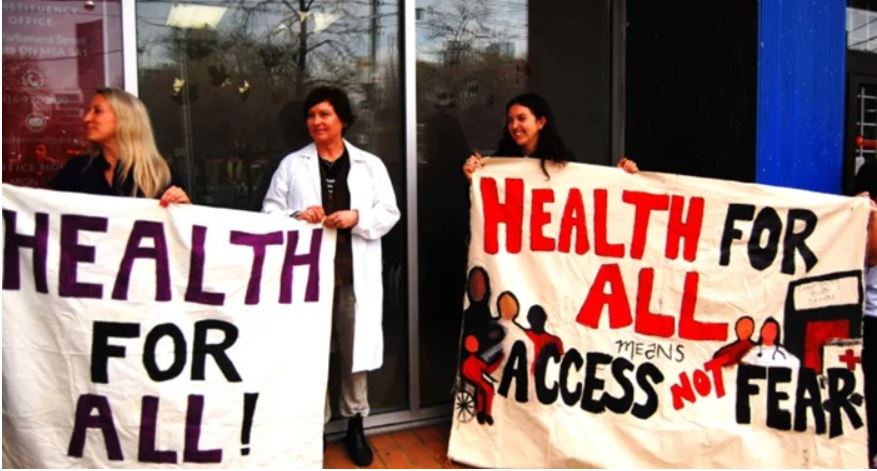
Demonstrations have taken place in several cities across Canada, with protesters calling on the federal government to withdraw planned reductions to a healthcare programme for refugees and asylum seekers.
In Toronto, dozens gathered on Tuesday as part of a nationwide day of action opposing changes to the Interim Federal Health Program (IFHP), which are scheduled to take effect on May 1. Critics argue the reforms could place already vulnerable populations at greater risk and may ultimately increase pressure on the wider healthcare system.
Among those speaking at the protest was Dr Ritika Goel, who said the changes undermine the principle of universal healthcare and risk marginalising migrants and asylum seekers.
The IFHP provides temporary medical coverage for refugees, asylum claimants and other individuals not eligible for provincial health insurance in Canada. Under the new policy, beneficiaries will be required to pay a co-payment of $4 for eligible prescription drugs, along with 30 percent of the cost of additional services such as dental care, vision care and counselling.
A spokesperson for Immigration, Refugees and Citizenship Canada (IRCC) defended the changes, stating that the introduction of co-payments is intended to ensure the long-term sustainability of the programme. The department also said the adjustments align the IFHP with other publicly funded health schemes that include supplementary benefit contributions.
However, healthcare professionals and refugee advocacy groups have raised concerns that even modest charges could discourage newly arrived individuals—many of whom are already facing financial hardship—from accessing essential care.
Aisling Bondy, president of the Canadian Association of Refugee Lawyers, warned that reduced access to healthcare could have serious consequences for people who have recently arrived in the country and may already be dealing with trauma and instability.
The policy shift comes amid broader political and economic pressure in Canada, where immigration levels and public spending have become increasingly contentious issues. Public opinion on immigration has shifted in recent years, with rising concerns linked to cost-of-living challenges and housing shortages.
Since taking office in March 2025, Prime Minister Mark Carney’s administration has introduced tighter controls on temporary migration pathways, including international student and foreign worker visas, while also implementing new restrictions on asylum access. The government has simultaneously committed to large-scale spending reductions across multiple sectors.
According to the Office of the Parliamentary Budget Officer, the cost of the IFHP has risen sharply in recent years, increasing from about CAD $211 million in 2020–2021 to nearly CAD $896 million in 2024–2025, driven by both higher enrolment and rising per-person costs. The programme is expected to continue growing, though at a slower pace in the coming years.
The government estimates that the proposed changes could reduce costs by over CAD $120 million in 2026–2027, with further savings projected in subsequent years.
However, critics argue the reforms may have the opposite effect. Dr Margot Burnell, president of the Canadian Medical Association, said the policy could lead to higher long-term healthcare spending by pushing patients away from preventive care and into emergency services.
She also warned that increased administrative burdens on healthcare providers could further strain an already pressured system, adding that the changes risk effectively denying care to people living in poverty.
Similar reforms to the IFHP were introduced in 2012 under then-Prime Minister Stephen Harper, sparking protests and legal challenges. In 2014, the Federal Court ruled that some of the cuts were unconstitutional, describing their impact as “cruel and unusual” treatment. The policy was later reversed after the 2015 federal election.