Sri Lanka
 USA
USA Canada
 India
India UK
UK UAE
UAE




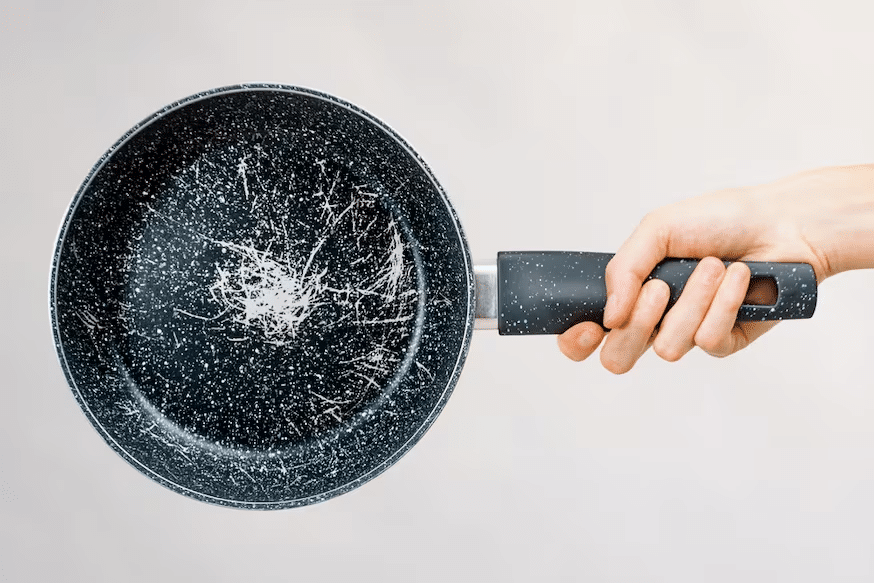
Nonstick cookware has been linked to toxic “forever chemicals” before, but a new study has put a number on how many plastic particles can leak from a single crack on a frying pan.
A surface scratch on Teflon coating may shed more than 9,000 micro- and nanoparticles, potentially contaminating food with harmful chemicals, according to a study by researchers from the Global Centre for Environmental Remediation.
Most nonstick cookware contains trace amounts of per- and polyfluoroalkyl substances, known as PFAS for short. Exposure to certain PFAS has been linked to a greater risk of health conditions including liver disease, chronic kidney disease, high blood pressure, and some cancers.
Teflon-coated cookware was made with a chemical called PFOA (perfluorooctanoic acid) until 2013, when a landmark study found a greater occurrence of kidney and testicular cancers in people with high levels of exposure. Nowadays, Teflon is manufactured with newer-generation PFAS, some of which have been linked to similar health risks.
The study findings demonstrate how even a small crack in nonstick coating can shed thousands of potentially harmful particles — closer to millions when cooking with a worn-down pan, researchers estimated.
As some of those particles inevitably end up in food, it’s important to choose safe cookware for your kitchen, the researchers concluded. Ceramic-coated cookware is an increasingly popular, PFAS-free alternative to Teflon.
“It gives us a strong warning that we must be careful about selecting and using cooking utensils to avoid food contamination,” Youhong Tang, a professor from the College of Science and Engineering at Flinders University in Australia, said in a press release.
Millions of particles may be released from Teflon cookware in the kitchen
The research team, which was based in Australia, developed an algorithm to count the particles that may be shed from nonstick cookware.
Using their algorithm, along with molecular imaging, they estimated that thousands to millions of Teflon microplastics and nanoplastics — as many as 2.3 million — may be released from a pan’s broken coating in the time it takes to cook a meal.
“Given the fact PFAS is a big concern, these Teflon microparticles in our food might be a health concern [that] needs investigating,” Cheng Fang, a researcher from the University of Newcastle, said in the release.
It’s all the more reason to take caution in the kitchen, the researchers said. Most nonstick pans have instructions that say not to heat them above medium, in order to avoid the release of potentially harmful fumes from Teflon cookware.