Sri Lanka
 USA
USA Canada
 India
India UK
UK UAE
UAE




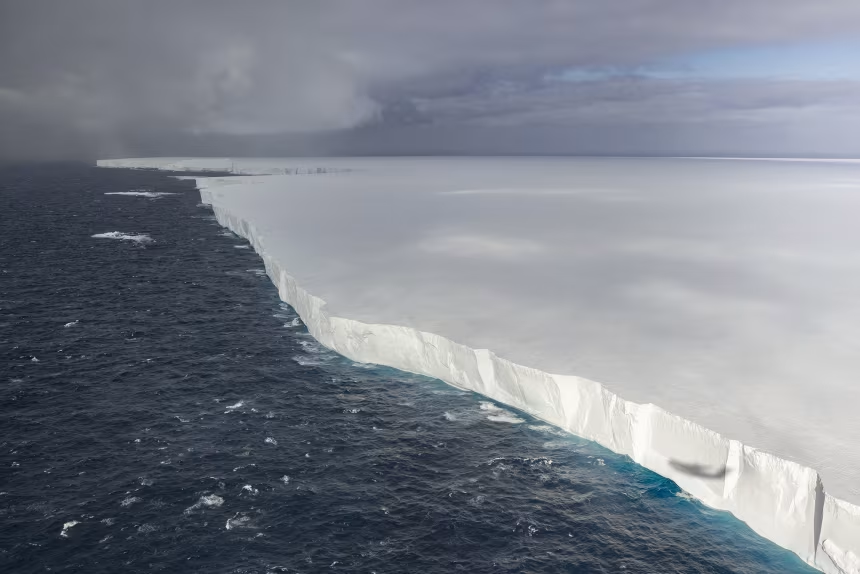
For nearly forty years, the iceberg known as A23a has fascinated scientists. Once the largest iceberg on Earth, it weighed close to a trillion metric tonnes and stretched across 3,672 square kilometers — an area slightly bigger than the US state of Rhode Island. But now, researchers say this “megaberg” is rapidly breaking apart into several massive chunks.
A23a has been under observation since 1986, when it split from the Filchner-Ronne ice shelf in Antarctica. For more than 30 years, it remained stuck on the seabed of the Weddell Sea, before finally loosening in 2020 and beginning a long journey through Antarctic waters. Along the way, it grounded, floated free, and was pushed by powerful ocean currents in what scientists call “iceberg alley.”
Dr. Andrew Meijers, an oceanographer with the British Antarctic Survey (BAS), explained that the iceberg’s current breakup follows a common pattern. “It has been shedding very large chunks, each of which is now tracked separately as new icebergs,” he said. Today, A23a has shrunk to about 1,700 square kilometers — roughly the size of Greater London.
The disintegration of A23a means it has lost its crown as the world’s largest iceberg. That title now belongs to D15a, a giant measuring around 3,000 square kilometers, which currently rests near Australia’s Davis research base. A23a still ranks as the second largest, though scientists expect it will keep fragmenting in the coming weeks, likely into pieces too small to follow.
Icebergs calving and breaking up are natural events, but climate change is intensifying the process. Warmer ocean temperatures and shifting currents are causing Antarctica’s ice shelves to lose trillions of tonnes of ice, raising concerns about long-term sea level rise. “We don’t yet know if giant icebergs are forming more often,” Meijers noted, “but we do know that human-driven warming is reshaping Antarctica in alarming ways.”
Researchers onboard the BAS research ship RRS Sir David Attenborough visited A23a earlier this year, while it was grounded near South Georgia in the South Atlantic. They collected samples to study how such massive icebergs affect marine ecosystems. According to BAS, the release of enormous amounts of cold, fresh water from A23a likely disrupted life on the seabed and in surrounding waters.
For scientists, A23a’s story is more than a tale of ice breaking apart — it is a window into the future of a warming planet. As global temperatures rise, giant icebergs like A23a may become more common, carrying with them profound consequences for oceans, wildlife, and people around the world. CNN