Sri Lanka
 USA
USA Canada
 India
India UK
UK UAE
UAE




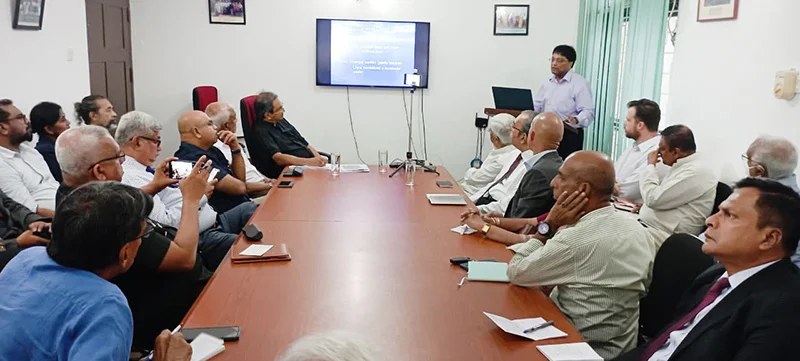
The strategic competition between the United States and China has become one of the defining features of contemporary international politics. However, balanced and comprehensive assessments of this rivalry are often rare—especially for observers from the Global South who must navigate the consequences of great-power tensions. Recognizing this gap, the Regional Centre for Strategic Studies (RCSS) in Colombo hosted a special forum on December 8, titled “The US-China Rivalry and Implications for the Indo-Pacific,” featuring Professor Neil DeVotta of Wake Forest University, USA.
The event drew a diverse audience, including diplomats, senior public officials, academics, civil society leaders, military officers and media personnel. The discussion was moderated by RCSS Executive Director, former ambassador Ravinatha Aryasinha, and concluded with an engaging Q&A session.
Professor DeVotta challenged the common global narrative of China’s rapid rise by highlighting several under-discussed realities:
China’s economic slowdown: Capital flight has increased, and China appears trapped at middle-income levels without transitioning into a high-income economy.
Population decline and migration: Significant numbers of Chinese citizens are seeking to leave the country, including attempts to enter the United States.
Strengthening Party control: Despite private sector activity, state-owned enterprises remain powerful, and Communist Party cells are now embedded within private firms.
Peak power concerns: China may be at the height of its power—creating incentives for more assertive behaviour, including potential military action against Taiwan.
Hard authoritarianism: The central government continues to favour strong authoritarian control, contradicting predictions that it would soften into a Singapore-style system.
Rising Western influence: China’s presence and influence in Western societies remain stronger than ever.
Regarding the United States, the professor offered key insights:
A prolonged unipolar moment: The US continues to dominate global power structures, an unusually extended period for any major power.
Viewing China as a revisionist power: The US sees China as seeking incremental changes to the international order.
Shift away from soft power: The latest US national security strategy focuses less on soft power and more on hard power.
Protecting Asia-Pacific balance: The US remains committed to preventing any single nation from dominating the region.
Strengthening ties with India: Washington emphasizes deepening economic cooperation with India while referencing China sparingly.
Given these dynamics, Professor DeVotta stressed that economically vulnerable nations of the Global South must rethink how they ensure their survival and prosperity. He observed that the Non-Aligned Movement (NAM), once powerful, has significantly weakened.
Yet, the columnist argues that NAM did not naturally fade—it was allowed to decline. As long as structural inequalities between North and South persist, the principles of non-alignment remain relevant. Many developing nations worsened their challenges by adopting market-driven economic models without adequate safeguards.
In the emerging geopolitical landscape, the Global South may need to re-organize and consider forming stronger partnerships—especially with India, which the US views as a key regional actor. However, the absence of exceptional leadership, unlike in the era of Jawaharlal Nehru, has hindered collective Southern progress.
The article concludes that rebuilding effective leadership and reviving cooperative frameworks, inspired by original NAM principles, are essential for Global South nations to navigate great-power rivalry while securing equitable global economic participation.