Sri Lanka
 USA
USA Canada
 India
India UK
UK UAE
UAE




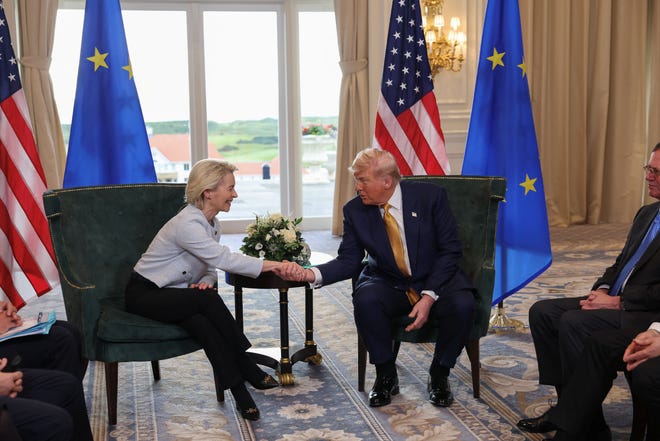
Just days before the self-imposed August 1 deadline, U.S. President Donald Trump has secured a significant trade agreement with the European Union, echoing recent deals with Japan and other key trading partners.
The agreement, reached during Trump’s meeting with European Commission President Ursula von der Leyen in Scotland, includes a 15% tariff on most European exports to the United States. Although higher than the 10% rate EU leaders hoped for, the figure marks a reduction from the 30% tariff Trump had previously threatened.
As part of the deal, the EU will purchase $750 billion worth of U.S. energy and invest $600 billion in U.S. energy and military sectors — totaling a staggering $1.35 trillion economic package.
“This is a huge deal between the world’s two largest economies,” von der Leyen remarked. “It brings stability and predictability.”
Trump, often critical of the EU’s trade practices, called the deal a major win: “I think we both wanted to make a deal. I think it’s going to be great for both.”
The 15% tariff will apply broadly, including to automobile exports. However, existing tariffs on steel and aluminum will remain at 50%.
European leaders have largely welcomed the agreement. German Chancellor Friedrich Merz noted it had averted a damaging trade conflict, particularly for Germany’s export-heavy economy. Italian PM Giorgia Meloni hailed it as a “positive” development, and Ireland’s Trade Minister Simon Harris emphasized the certainty it brings to transatlantic trade.
Despite this success, the Trump administration signals more aggressive trade actions ahead. Commerce Secretary Howard Lutnick revealed that further tariffs, particularly on semiconductors, are under consideration.
While Trump continues to reshape U.S. global trade policy, this EU deal marks another step in his goal to reduce trade deficits and recalibrate international economic relations.