Sri Lanka
 USA
USA Canada
 India
India UK
UK UAE
UAE




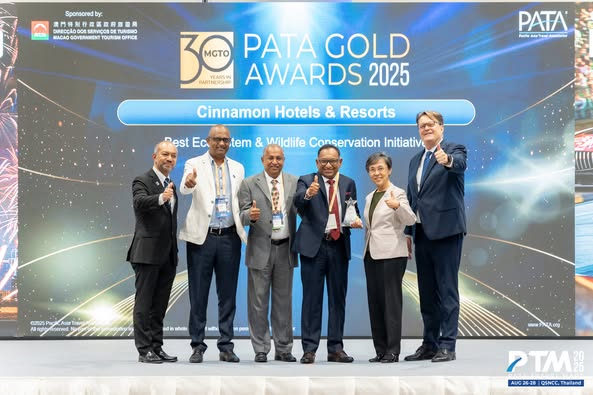
Sri Lanka’s Cinnamon Hotels & Resorts has been recognised by the Pacific Asia Travel Association (PATA) with the 2025 Gold Award for Best Ecosystem & Wildlife Conservation for the Cinnamon Rainforest Restoration Project, underscoring the organisation’s deep-rooted commitment to environmental stewardship and innovative ecosystem rehabilitation across the island.
Launched in 2022, the project occupies 59 acres in Suduwelipotha, situated in Sri Lanka’s richly biodiverse wet zone. Once severely degraded, the site has been revitalised into a flourishing refuge for endemic and vulnerable wildlife, demonstrating the capacity of the private sector to lead effective and enduring conservation.
Devised to safeguard and renew the island’s extraordinary natural heritage, the project simultaneously illustrates a sustainable tourism paradigm and showcases the direct benefits tourism can generate for conservation. The ongoing revitalisation reaffirms the pivotal function that the sector can fulfil in preserving the country’s ecological networks.
The Cinnamon Rainforest Restoration Project constitutes a structured programme of rehabilitation targeting ecosystems modified by anthropogenic and incremental decline. Located within Sri Lanka’s wet zone, an internationally defined centre for rare biological enrichment, the initiative concentrates on restoring environments vital to endemic plant and animal life. The monitoring, plant propagation, and threat mitigation measures implemented will enhance the reservoirs of gene flow while, at the same time, providing ecosystem services directly supportive of neighbouring tourism operations.
Since the initiative commenced, it has recorded extraordinary advancement: 22,797 native trees have been established, achieving an 85-90% survival rate, and the ongoing restoration has yielded the identification of 36 previously undocumented plant species, among which is the noteworthy reintegration of Pini Beraliya (Doona ovalifolia), a timber species formerly considered extinct in situ, underscoring a key success in conservation biology.
Faunal surveys conducted within the restoration zone have catalogued 251 vertebrate and invertebrate taxa, 54 of which are recognised as endemic and 43 recorded as globally significant by national threat assessments. Persevering protection of these taxa is assured through the multi-layered approach instituted by the project, which integrates silviculture with habitat management to establish a stable corridor in which biota continue to reproduce.
The sustained viability of the Cinnamon Rainforest Restoration Project derives from a synergistic network encompassing cabinet ministries, locally registered NGOs, and corporate stewardship. Allocation of an operational estate ensued from the Sri Lanka Forest Department, an exercise that demonstrates the decisive levers exercised by state agencies and the constitutional imperative extending from their legislative mandate to bolster rational and inclusive management of the country’s natural patrimony.
Cinnamon Hotels & Resorts is partnered not only by the region’s best ecologists within its own Nature Trails team but also by the John Keells Foundation, which supplies the necessary funding, and the Sri Lankan NGO Ruk Rekaganno (The Tree Society), charged with carrying out ground-level activities. Their respective expertise is complemented by an overarching scientific direction, enabling coherence and rigor at every operational layer. This synergy illustrates that enduring ecological restoration is best pursued through joined portfolios of finance, governance, and technical capacity.
Such collaborative architecture goes beyond demonstration; it operationalises a pathology of influence through which the hospitality sector, reconciled with expert institutions and the wider community, systematically steers ecological recovery. The model signifies that travel, when tethered productively to charitable and scholarly agencies, accelerates restorative momentum and mobilises incentive structures friendly to resilience.
The initiative is anchored within Sri Lanka’s wider sustainable tourism narrative. The country’s tourism growth reinforces a practical axiom: long-term sector vitality is imperilled without residual biodiversity and minimal ecological breach. The initiative offers guests empirical evidence of accelerating recovery, making ecological restoration a field of engagement equally compelling and profitable.
Cinnamon Hotels & Resorts marries modern hospitality to a sustainability agenda by channelling organic stimulation into every service. The curriculum interconnects operators, ownership, and guests in a balanced ledger of prosperity, convincingly illustrating that luxury and accountability are not antithetical but congruent partners in long-term commercial value.
The Cinnamon Hotels & Resorts group, in active partnership with regional conservation organisations, is redefining Sri Lanka’s eco-tourism landscape. The parallel advance of the Rainforest Restoration Project not only demonstrates ecological revitalisation but also advances community welfare by cultivating a collective understanding of environmental stewardship and supplying eco-tourism options whose revenues are reinvested locally.
Encouraging Responsible Journeying
The award of a PATA Gold medal not only is a tribute to Cinnamon’s exemplary conservation stewardship but also catalyses a global dialogue regarding responsible journeying. Amid escalating concern over the impacts of overtourism and ecosystem decline, the Cinnamon Rainforest Restoration Project stands as a persuasive testament that the travel sector can constitute a crucial agency of ecological governance.
When tourists align with sustainable enterprise, they augment conservation momentum while securing the viability of Sri Lanka’s wilderness for succeeding generations. The Rainforest Restoration Project thus illustrates how the sector can evolve from a conventional luxury model into a proactive exemplar of sustainable deliberation, presenting guests with the chance to experience untouched ecosystems while ensuring their enduring integrity.
Conclusion: Advancing the Frontiers of Eco-Tourism
The Cinnamon Rainforest Restoration Project stands as a compelling example of how Sri Lanka’s tourism industry can catalyse wildlife preservation and landscape rehabilitation. Distinguished by the PATA Gold Award for Best Ecosystem and Wildlife Conservation, the undertaking now establishes a durable benchmark for sustainable tourism practice across the region. In an era when informed travellers increasingly demand responsible and purposeful itineraries, such initiatives will remain instrumental in safeguarding the globe’s most irreplaceable ecological assets.
Source : https://www.travelandtourworld.com/