Sri Lanka
 USA
USA Canada
 India
India UK
UK UAE
UAE




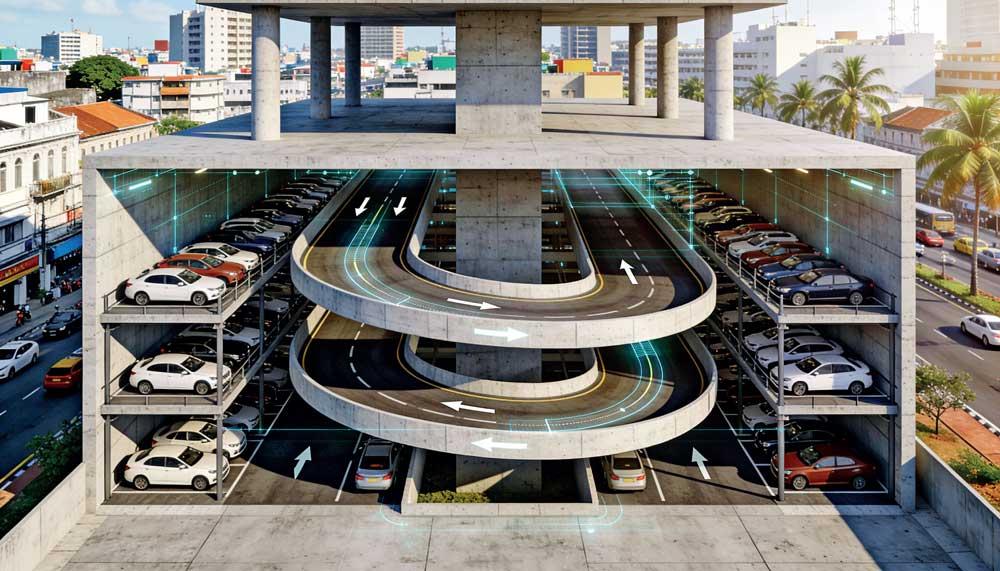
Colombo’s worsening parking shortage is prompting Sri Lankan designers to rethink the conventional multi-storey car park, with a locally developed concept offering a potential breakthrough. Known as the rectangular double-helical car park, or ParkDense, the design aims to increase parking capacity by around 30% while reducing internal congestion—without relying on expensive mechanical systems.
With more than half a million vehicles entering Colombo daily and limited off-street parking available, drivers often face long searches for parking and overcrowded streets. As land values rise and urban density increases, traditional two-way ramp parking structures are proving inefficient, consuming valuable floor area while still failing to meet demand.
The double-helical concept reorganises internal circulation by separating upward and downward vehicle movement into two distinct one-way ramps within a rectangular footprint. Drivers enter at ground level and follow a dedicated upward ramp to park, then exit using a separate downward ramp. This eliminates head-on encounters, tight turning conflicts and frequent stoppages common in conventional layouts.
Unlike automated or robotic parking systems, the design is entirely manual and low-tech, requiring no car lifts, stackers or conveyors. Drivers park their own vehicles as usual, with the efficiency gains coming purely from smarter geometry rather than added machinery.
Preliminary design studies suggest that the one-way ramp system allows more of the building’s volume to be used for parking bays rather than circulation space. For the same footprint and height, this can translate into roughly 30% more parking stalls compared to a traditional two-way ramp garage. In practical terms, this could mean accommodating more vehicles, reducing the number of floors needed, or freeing up space for other uses.
Traffic-flow analysis also indicates smoother movement within the structure. By separating opposing traffic streams, the double-helical layout reduces conflict points, queues and bottlenecks, particularly during peak hours. Drivers benefit from fewer delays and safer manoeuvring, while operators may see lower accident rates and maintenance costs.
The system also offers flexibility for future development. As a conventional reinforced-concrete structure, it can be designed to support additional floors above, such as offices, apartments or commercial spaces, allowing parking facilities to evolve into mixed-use developments over time.
While not a substitute for better public transport or traffic management, the rectangular double-helical car park presents a locally developed, practical refinement to existing parking infrastructure—showing how smarter design can help Colombo manage its urban space more efficiently.