Sri Lanka
 USA
USA Canada
 India
India UK
UK UAE
UAE




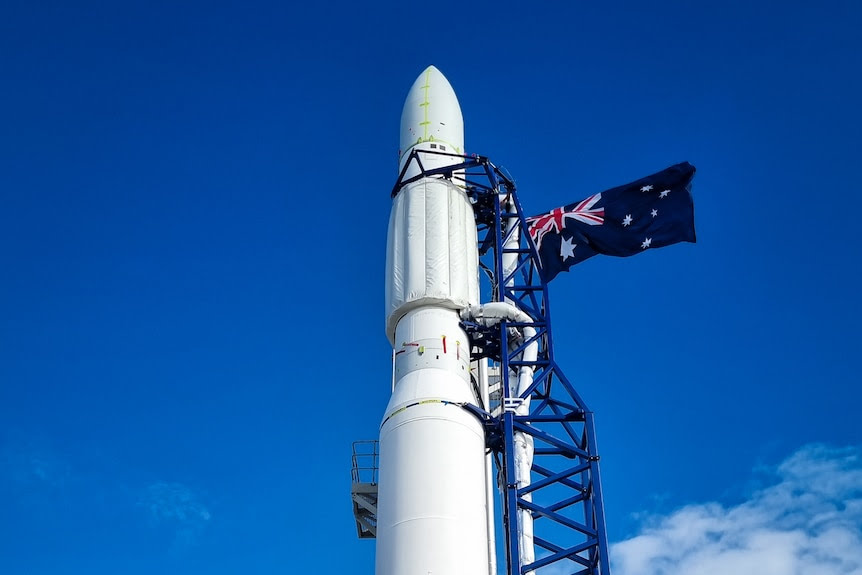
Australia has long played a crucial behind-the-scenes role in the global space industry, famously helping NASA broadcast the first moon landing to the world. But despite this legacy, the country has struggled to establish its own space launch capabilities.
This week, Gilmour Space Technologies faced another delay in its historic Eris rocket launch, scrubbing two attempts due to technical issues. A third attempt is expected next month.
According to Dr Rebecca Allen from Swinburne University, while Australia’s geography and expertise give it potential, the country has lacked the political will and long-term investment to truly lead in the space sector. “It’s a question of motivation,” she says. “Where’s the drive to lead instead of support?”
Still, the Eris launch represents a significant step. “It shows that Australia has the capacity to design and build aerospace vehicles,” Dr Allen said. “We’re not just a supporting player anymore.”
A Billion-Dollar Opportunity
The Space Industry Association of Australia (SIAA) says the global space economy is projected to reach $1.8 trillion USD by 2035. CEO Dan Lloyd notes that while Australia has the geographic advantage, it must move beyond simply offering launch sites and develop a strong, clear national space policy.
“There’s enormous potential here,” says Lloyd. “But we need to decide where we want to place our bets—and there are some excellent ones.”
Beyond economic benefits, Lloyd highlights the need for domestic space capabilities to manage natural disasters. Australia often depends on foreign satellite data, which can become unavailable during critical times. “That puts us at risk when every second counts,” he said.
Australia’s Path Forward
Enrico Palermo, head of the Australian Space Agency, says efforts are underway to create a more attractive environment for investment and innovation. This includes partnerships like the Technology Safeguards Agreement with the U.S., allowing American space tech to be launched from Australian soil.
Meanwhile, another opportunity looms: space debris. The number of active satellites has exploded—from 2,000 less than a decade ago to nearly 10,000 today, over 7,000 of which belong to Elon Musk’s Starlink. With more satellite constellations planned by Amazon, China, and others, space junk is becoming a serious global problem.
But for Lloyd, that’s also a business opportunity. “Australian companies are already researching ways to harvest and recycle space debris—turning it into new propulsion materials,” he said. “It’s a niche that we could lead.”