Sri Lanka
 USA
USA Canada
 India
India UK
UK UAE
UAE




Sri Lanka Police has issued urgent public guidelines following a sharp rise in reports of lost and stolen mobile phones, warning that unsecured devices could lead to repeated victimisation and serious legal consequences.
The Sri Lanka Police has issued a comprehensive set of public guidelines amid a growing number of complaints related to lost and stolen mobile phones during 2024 and 2025. Authorities highlighted the risks associated with personal data exposure, including private photographs, digital identities, and confidential communications, urging users to take immediate action if their devices go missing.
Police Spokesman ASP F.U. Wootler warned that lost or stolen phones can be misused by criminals, potentially causing repeated harm to the owner. He noted that victims could face serious consequences if their SIM cards are exploited for illegal activities.
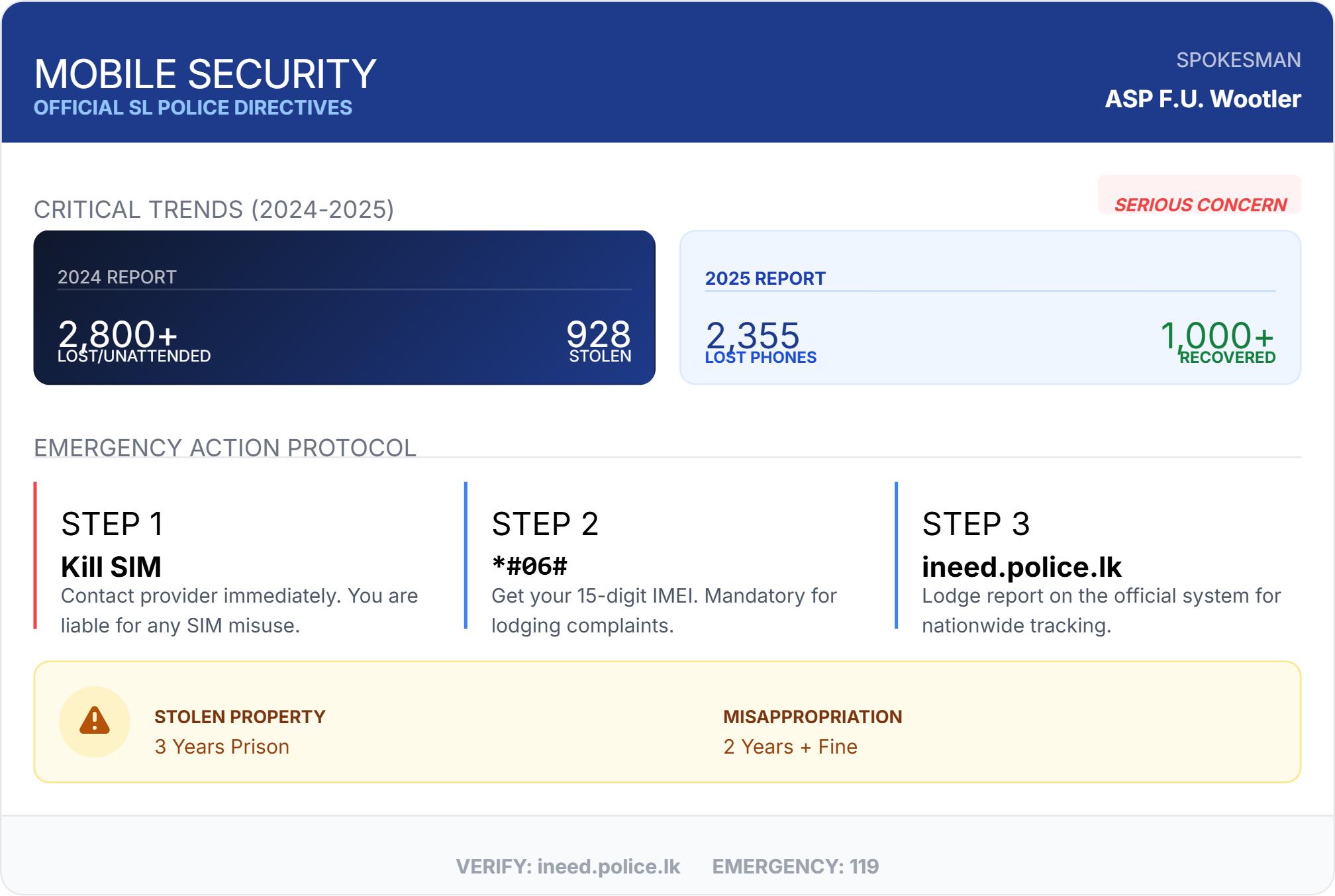
According to police statistics, more than 2,800 mobile phones were reported lost or unattended in 2024, while 928 were confirmed stolen. In 2025, 2,355 phones were reported lost, and over 1,000 stolen devices were recovered, indicating that mobile device theft and loss remain a major concern.
The police advised users to immediately deactivate their SIM cards by contacting their service providers if their phones are lost. They also urged the public to obtain their 15-digit International Mobile Equipment Identity (IMEI) number by dialling *#06# and keep a printed copy, as it is required when filing a complaint.
Complaints regarding lost devices should be submitted through the online “iNeed” system, which assists law enforcement in tracking stolen and lost phones nationwide. Authorities also warned the public against purchasing second-hand phones from unauthorised sellers, as possession of stolen property could result in a prison sentence of up to three years.
Furthermore, individuals who find lost phones are legally required to hand them over to the police. Failure to do so could lead to charges of criminal misappropriation, punishable by up to two years in prison and a fine.
ASP Wootler urged the public to follow these guidelines to protect their digital security and contribute to a safer technological environment in Sri Lanka.