Sri Lanka
 USA
USA Canada
 India
India UK
UK UAE
UAE




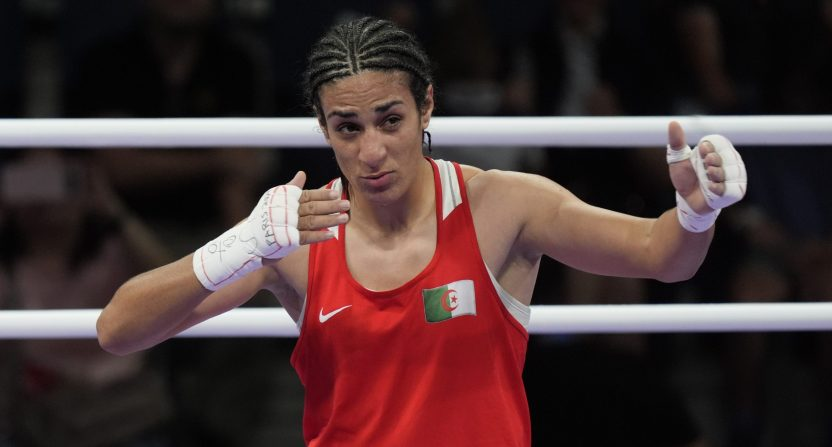
Algerian Olympic champion boxer Imane Khelif, who became the centre of controversy at Paris 2024 over her eligibility, has lodged an appeal with the Court of Arbitration for Sport against World Boxing’s decision to bar athletes from competing without a genetic certificate.
CAS announced the news on Monday. “The parties are currently exchanging written submissions, and a hearing will be scheduled with their agreement,” CAS added in a statement.
Khelif announced weeks ago that she would not be taking part in the Women’s World Championships, which begin in Liverpool on Thursday and run until 14 September. At this event, World Boxing revealed that it would implement mandatory testing for the first time, albeit only in the women’s category. For men, the organisation has set 1 January 2026 as the start date.
In its statement, CAS said that Khelif’s legal move seeks to overturn the ruling in order to compete in Liverpool without undergoing the test. It added that her request to suspend the decision while the case is under review had been rejected.
The Algerian boxer has been under intense scrutiny since last summer, when she was disqualified from the 2023 World Championships by the International Boxing Association (IBA) for failing eligibility tests. However, the International Olympic Committee admitted her to the French Games. The IBA had declared her ineligible, but the IOC permitted her to compete alongside Taiwanese boxer Lin Yu-ting, who had also been disqualified by the IBA for the same reason.
In 2023, the IOC withdrew Olympic recognition from the IBA and took responsibility for organising the boxing tournament at Paris 2024. For decades, the former governing body of the sport has been trying to defend itself in court while the IOC has been seeking an alternative governing body, warning that if one is not found, boxing could be dropped from the Olympic programme.
As the conflict between the IBA and the IOC escalated amid the Paris debate, the IOC granted recognition to World Boxing in March of this year. One of the first decisions made by the newly recognised body, announced in May, was to introduce compulsory gender testing for male and female boxers – a policy that the IBA had advocated from the outset. This decision was based on the recommendations of an expert panel that had assessed the situation and officially approved the measure, making World Boxing the first global association to enforce it. From September, World Athletics will require a one-off SRY gene test for all female athletes at international championships, thereby reinforcing its transgender participation policy.
In light of this, World Boxing apologised to Khelif for publicly announcing her name when they made the decision to introduce mandatory sex testing. The organisation’s president, Boris van der Vorst, admitted that Khelif’s privacy should have been better protected.
Khelif, who competed in numerous women’s events and repeatedly stated that she was born female, crowned her career at the age of 26 with an Olympic gold medal in the super-welterweight division in Paris. She has made it clear that she has no intention of retiring. She has expressed her ambition to repeat her Olympic success and has already set her sights on the 2028 Games in Los Angeles.
It remains to be seen what position the IOC will take in this context. Its president, Kirsty Coventry, has not yet taken a stance and is studying the issue before making an official decision on gender eligibility rules.