Sri Lanka
 USA
USA Canada
 India
India UK
UK UAE
UAE




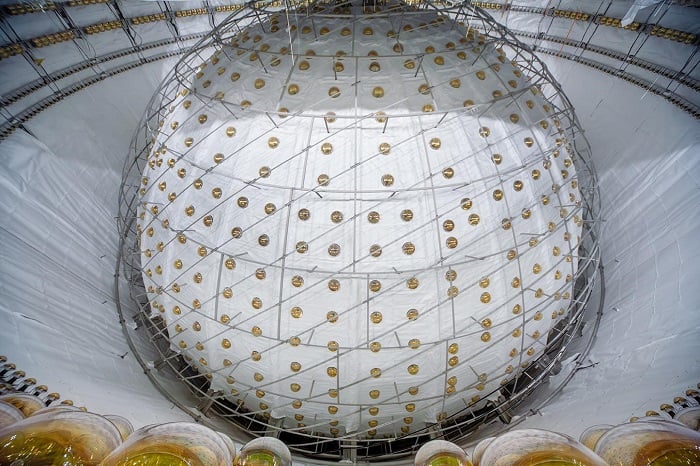
Neutrinos—tiny, ghostlike particles that rarely interact with matter—are among the greatest mysteries of modern physics. Though nearly 400 trillion solar neutrinos pass through the human body every second, detecting them is a monumental challenge. Now, China’s Jiangmen Underground Neutrino Observatory (JUNO) has officially begun collecting data, marking a major step in understanding these elusive particles.
A Detector Built for Precision
Located 700 meters underground in Jiangmen, between the Yangjiang and Taishan nuclear plants, JUNO is designed to capture between 40–60 neutrino events each day for the next decade. Nuclear reactors in the area provide an additional source of artificial neutrinos, boosting the chances of successful detection.
To minimize interference, JUNO is encased in a 44-meter pool of ultrapure water and equipped with a “Top Tracker” detector. This extra shield filters out stray cosmic particles that might create false signals, allowing researchers to isolate true neutrino interactions.
At its heart lies a massive liquid scintillator sphere, surrounded by more than 43,000 highly sensitive photodetectors. These instruments can detect individual photons produced when neutrinos interact, helping scientists map their properties with unprecedented detail.
Unlocking the Neutrino Puzzle
Neutrinos exist in three forms—electron, muon, and tau—and have the unique ability to switch between types, a process called oscillation. One of JUNO’s key missions is to determine the mass hierarchy of neutrinos: which type is heaviest and which is lightest. Researchers also hope to refine measurements of oscillation frequencies, which could offer fresh insights into particle physics.
Why Neutrinos Matter
Cracking the neutrino mystery could reshape multiple scientific fields. In cosmology, they may hold clues to the universe’s rapid expansion after the Big Bang. In astrophysics, they help explain supernova explosions. Even in geology, neutrinos emitted from radioactive rocks deep inside Earth reveal processes hidden beneath the crust.
A Global Collaboration
JUNO is the result of a massive international effort, involving 74 institutes and 700 scientists, led by the Chinese Academy of Sciences’ Institute of High Energy Physics. The project is expected to run for at least ten years, gradually building a dataset that could transform our understanding of the universe.
If successful, JUNO will mark a milestone in particle physics—pushing humanity closer to unlocking the secrets of the cosmos.