Sri Lanka
 USA
USA Canada
 India
India UK
UK UAE
UAE




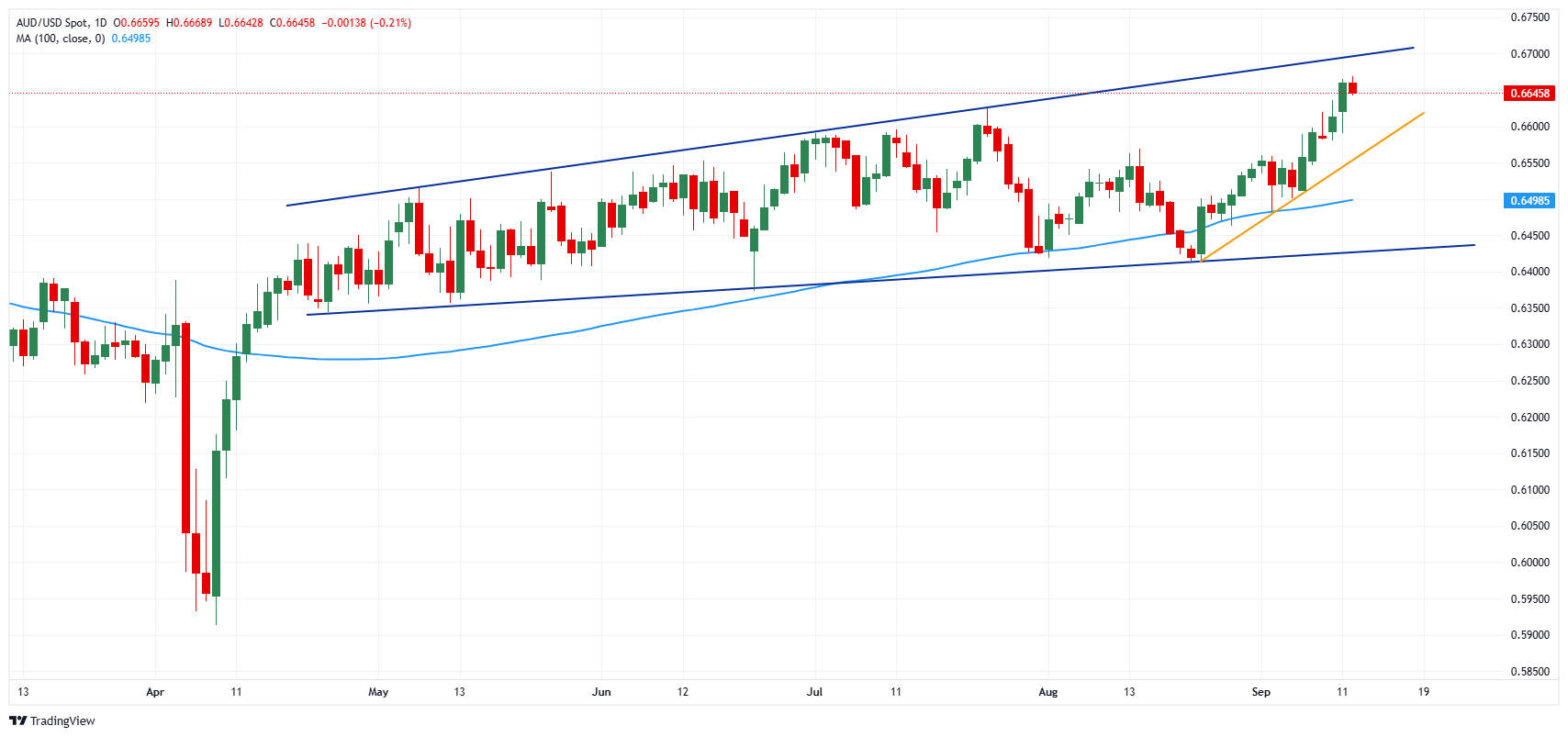
The Australian Dollar (AUD) traded slightly lower on Friday, slipping 0.15% below 0.6650 against the U.S. Dollar (USD). Market sentiment remains cautious as traders await the release of China’s Industrial Production and Retail Sales data on Monday, figures that are crucial for Australia’s export-driven economy.
The AUD/USD pair saw limited volatility this session, in contrast to Thursday’s movements sparked by U.S. inflation data. Analysts warn that disappointing Chinese figures could revive concerns over weaker demand for commodities—Australia’s key exports of iron ore, coal, and natural gas—and weigh heavily on the Aussie.
China’s Influence on the AUD
China remains Australia’s largest trading partner, making its economic data pivotal for AUD traders. Forecasts for August suggest Industrial Production growth of 5.8% (slightly up from July’s 5.7%) and Retail Sales growth of 3.8% (up from 3.7%). Yet, analysts warn these numbers mask slowing momentum, with persistent deflationary pressures clouding the outlook.
In July, Industrial Production hit its lowest level in eight months, while Retail Sales underperformed expectations. China’s Consumer Price Index (CPI) also dropped by 0.4% in August, deepening fears of prolonged deflation. This trend could dampen commodity demand and reduce Australian mining revenues.
Policy and Market Outlook
Beijing has introduced targeted measures to support consumption but stopped short of major stimulus. As Societe Generale’s Michelle Lam notes, pressure for stronger action may intensify as winter nears.
Meanwhile, the Reserve Bank of Australia (RBA) has signaled a pause in rate hikes, citing easing domestic inflation and uncertainty over global demand. As a result, the AUD’s trajectory is increasingly tied to Chinese economic health rather than RBA policy.
Technical Analysis
Despite Friday’s slight dip, AUD/USD remains within an uptrend channel established since May. Resistance lies near 0.6700, with a potential upside target at 0.6800 if momentum continues. However, risks of a pullback are growing: weaker Chinese data could trigger a decline toward 0.6570, with further downside possible near 0.6430 if bearish momentum accelerates.
For now, traders are keeping a close eye on Monday’s Chinese economic releases, which could set the tone for the Aussie’s next big move.