Sri Lanka
 USA
USA Canada
 India
India UK
UK UAE
UAE




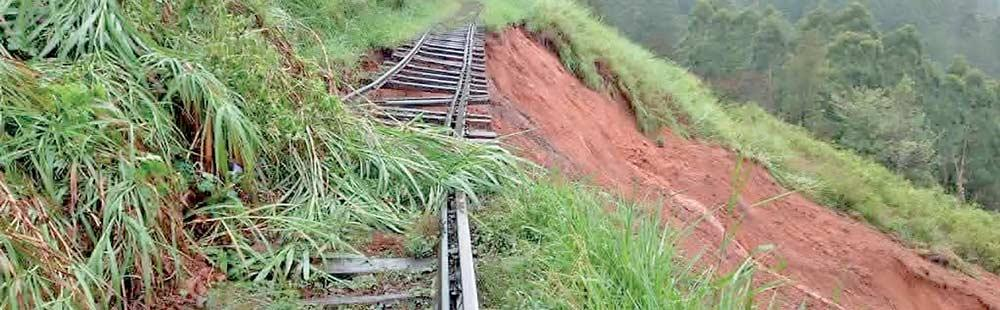
For generations, the upcountry railway line—Sri Lanka’s iconic Main Line—has been more than a mode of transport. It has been a living postcard, winding through misty mountains, emerald tea estates, terraced paddy fields and quiet hamlets, offering one of the most scenic train journeys in the world. Today, that beauty stands shattered.
Cyclone Ditwah has left the upcountry railway with a haunting, ghostly silence.
A Railway Carved Through Mountains
The upcountry railway stretches from Rambukkana to Badulla, branching off at Peradeniya towards Kandy–Matale and Badulla. This engineering marvel passes through 46 tunnels, all carved painstakingly through solid rock. The longest of them, the Singhimalai Tunnel, lies near Hatton railway station.
From Rambukkana, the railway line snakes through rural landscapes, crossing several unguarded level crossings where the only warning to villagers is the ringing bell and the distant sound of an approaching train. After Peliyagoda, it crosses the main highway to Kandy, and again near Polgahawela.
The first 85 kilometres run through the plains. Beyond Rambukkana, the line begins its dramatic ascent into the hills, revealing a breathtaking panorama of tea estates, lush vegetation, smiling paddy terraces and mist-covered slopes.
This route is home to Sri Lanka’s most celebrated trains—Udarata Menike, Podi Menike and Senkadagala Menike—beloved by commuters and tourists alike.
A Journey Loved by the World
The upcountry train journey has long been a highlight for foreign tourists. One of its crown jewels is the Nine Arch Bridge in Ella, a masterpiece of British-era engineering that transformed Ella into one of Sri Lanka’s most popular tourist destinations.
Thousands of visitors once travelled by train to Ella to witness this iconic bridge and spend days immersed in the surrounding natural beauty. That steady flow of tourists brought in valuable foreign exchange and sustained local livelihoods.
Today, that scenic journey no longer exists.
Cyclone Ditwah’s Trail of Destruction
Cyclone Ditwah has crippled the upcountry railway beyond recognition. Railway lines have been torn apart by landslides, bridges and culverts have collapsed, and entire sections of track beds have been washed away.
One of the most severe losses is the Black Bridge over the Mahaweli River at Peradeniya. Built in 1897, the 348-foot-long bridge is now dangerously leaning, forcing authorities to ban pedestrian use. A retired railway employee recalled witnessing similar damage during the floods of 1947, when part of the bridge collapsed into the river.
Extensive damage has been reported along multiple stretches, including:
- Rambukkana to Kadigamuwa
- Ihala Kotte to Kadugannawa
- Gampola to Nawalapitiya
- Areas near Gelioya, Kotagala, Talawakele, Great Western, Nanuoya and Pattipola
- Near the Ulapane brick bridge, where landslides and falling rocks devastated the track
In many locations, water flowing beneath the railway has eroded the track bed itself, rendering it unsafe.
A National Asset in Crisis
Established in 1858, the Sri Lanka Department of Railways is now 167 years old, operating nine railway lines spanning 1,508 kilometres. A senior railway official revealed that nearly 70 percent of the railway network has been affected by the Ditwah disaster.
The scale of destruction, officials say, is even greater than the damage caused to the southern railway line during the 2004 tsunami, which affected only 140 kilometres and was restored relatively quickly.
Unlike the coastal line, the upcountry railway runs through extremely difficult terrain, making restoration far more complex and time-consuming.
A Legacy Built by the British
The British colonial administration constructed the upcountry railway primarily to transport cash crops—first coffee and later tea—to Colombo. The project was completed in stages:
- Colombo to Ambepussa (1864)
- Ambepussa to Kandy (1867)
- Peradeniya to Nawalapitiya (1874)
- Nawalapitiya to Nanuoya (1885)
- Nanuoya to Bandarawela (1894)
- Bandarawela to Badulla (1924)
The Peradeniya–Kandy line was extended to Matale in 1880. However, the Nanuoya–Kandapola–Nuwara Eliya line was later closed due to losses and replaced by road transport.
The Pattipola Railway Station, standing at 6,240 feet above sea level, remains the highest point on Sri Lanka’s railway network.
The Long Road to Recovery
Restoration work on the railway line from Ambewela to Badulla is nearing completion, with test runs now being conducted to transport workers and construction materials.
Yet railway engineers warn that reopening the entire Main Line will require meticulous supervision, especially in landslide-prone areas. Attention must be paid to earth cracks, unstable slopes and rock-fall risks to prevent future disasters.
Officials admit they cannot provide a definite timeline for the full resumption of services. Many believe that foreign technical expertise is essential to safely restore several damaged sections.
A Hope That Still Runs on Steel Rails
Despite the devastation, hope remains alive.
Across the country, people long to once again see Udarata Menike, Podi Menike and Senkadagala Menike gliding through misty hills, tea gardens and winding valleys—restoring not just a railway line, but a symbol of Sri Lanka’s heritage, resilience and natural beauty.
The tracks may be broken, but the nation’s affection for its upcountry railway remains firmly intact.
Source : https://www.dailymirror.lk/