Sri Lanka
 USA
USA Canada
 India
India UK
UK UAE
UAE




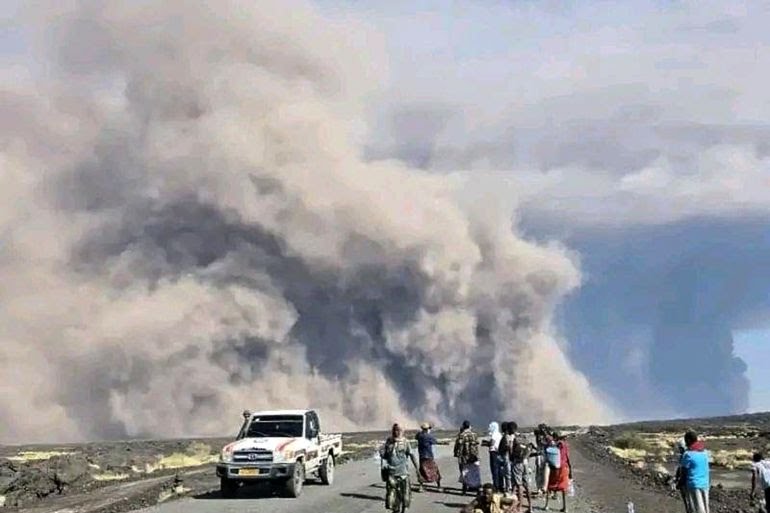
A volcano in northern Ethiopia has erupted for the first time in roughly 12,000 years, sending massive plumes of ash across the sky and triggering widespread flight cancellations in India and the UAE. The eruption occurred on Sunday at the long-dormant Hayli Gubbi volcano located in the Afar region, a geologically active zone formed by shifting tectonic plates.
Though no casualties have been reported, officials remain concerned about the impact on nearby communities and livestock. Villages surrounding the volcano have been blanketed in ash, affecting grazing lands and pushing several tourist routes to a standstill. Residents described the eruption as sudden and explosive, with one witness comparing the sound to a bomb blast.
How It Happened
According to the Toulouse Volcanic Ash Advisory Center (VAAC), Hayli Gubbi erupted around 11:30am local time, shooting ash clouds up to 45,000 metres (148,000 ft) into the atmosphere. Satellite images captured by the European Space Agency show ash spreading rapidly across the Red Sea and further east.
Before the eruption, locals reported seeing faint smoke days earlier, but there were no scientific warnings. The Smithsonian Institution confirms that the volcano has not erupted at any point during the Holocene — meaning this is its first eruption since the end of the Ice Age.
Impact on Villages and Livestock
Ash has covered entire settlements, including well-known tourist regions. In the village of Afdera, residents told AP News that the sky darkened, creating near-night conditions during the day. Local administrators warn that the ash has coated grazing fields, limiting food sources for livestock, which could lead to economic disruption in the herding community.
Historical Significance
Hayli Gubbi is part of the Erta Ale volcanic range, home to one of the world’s most active lava lakes. Despite its massive presence, Hayli Gubbi itself had remained silent for millennia — making this eruption a rare, historic geological event.
Ash Travels Across Borders: Flights Affected
Volcanic ash drifted over Yemen and Oman, eventually reaching Pakistan and India, where airlines were forced to cancel multiple flights.
In India, carriers such as Air India, IndiGo, Akasa, and KLM grounded several scheduled services due to engine safety risks posed by ash particles. Airports were instructed to check runways for contamination, and advisories were issued urging aircraft to avoid affected airspace.
India expects clearing skies by Tuesday as ash begins shifting towards China.
A Reminder From History
Volcanic ash events of this scale are rare. The last major aviation shutdown occurred in 2010 when Iceland’s Eyjafjallajökull eruption halted European air travel for six days, grounding nearly 95,000 flights.
Scientists are closely monitoring Hayli Gubbi as global aviation adjusts routes to avoid its ash cloud — marking one of the most significant volcanic disruptions in recent years.