Sri Lanka
 USA
USA Canada
 India
India UK
UK UAE
UAE




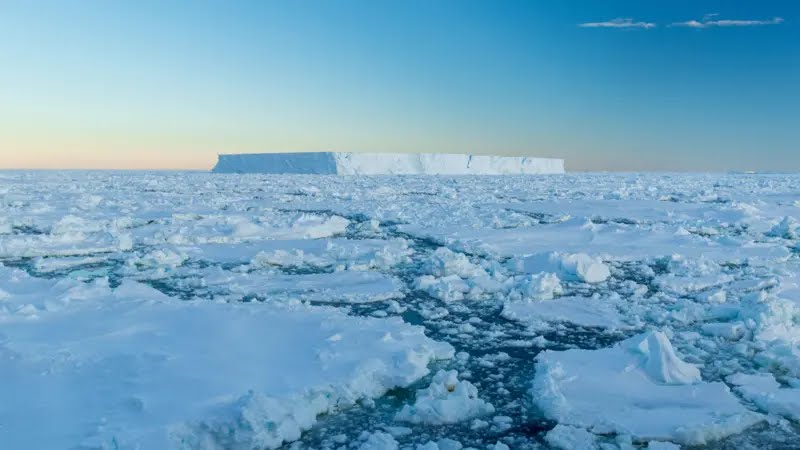
New research has uncovered deep scratches on the North Sea floor, revealing that enormous icebergs—some as wide as UK cities—once drifted along Britain’s coastline. The discovery offers significant insights into past climate conditions and raises questions about the future of Antarctica’s ice shelves in a warming world.
Scientists have found compelling geological evidence that massive icebergs, comparable in size to modern UK cities, once drifted along the British coastline more than 18,000 years ago. These city-sized icebergs, gouging comb-like grooves into the North Sea floor, point to the presence of ice shelves once extending from the British-Irish ice sheet.
The discovery marks the first direct evidence that the ancient ice sheet covering Britain and Ireland produced such large icebergs. Researchers identified these iceberg “fingerprints” using ultra-detailed 3D seismic data—similar to MRI scans—collected during ocean surveys conducted by oil, gas, and renewable energy projects.
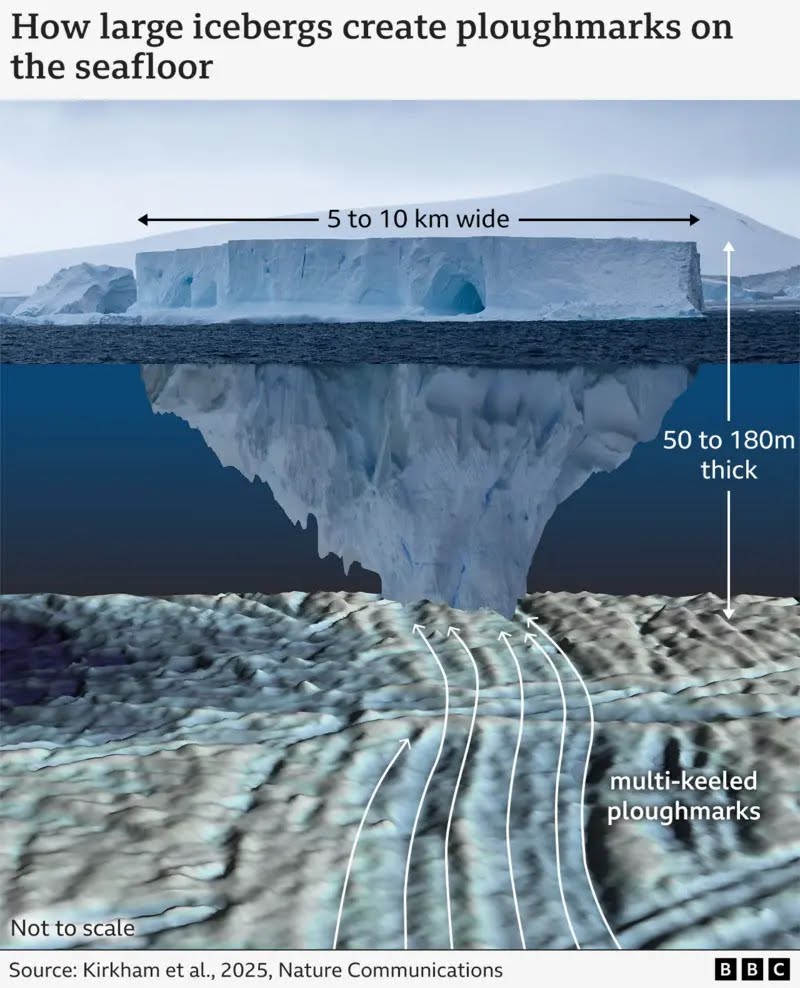
Lead author Dr James Kirkham, a marine geophysicist at the British Antarctic Survey, explained that the distinctive scratches were made by the keels of massive tabular icebergs. These bergs, flat-topped and wide, could only have been created by ice shelves, floating extensions of glaciers stretching into the sea.
“This shows definitively that the UK once had ice shelves,” Dr Kirkham said. The icebergs were estimated to be 5 to tens of kilometres wide and up to 180 metres thick—comparable in area to cities like Norwich or Cambridge.
The findings mirror present-day Antarctic conditions. In fact, Dr Kirkham recounted a moment in Antarctica when he saw an iceberg similar in size to those now confirmed to have existed off Scotland’s shores during the last Ice Age.
This research has implications far beyond British geological history. Ice shelves are crucial in slowing the movement of inland glaciers into the ocean. Their collapse can accelerate ice loss, raising global sea levels—a process already being observed in Antarctica.
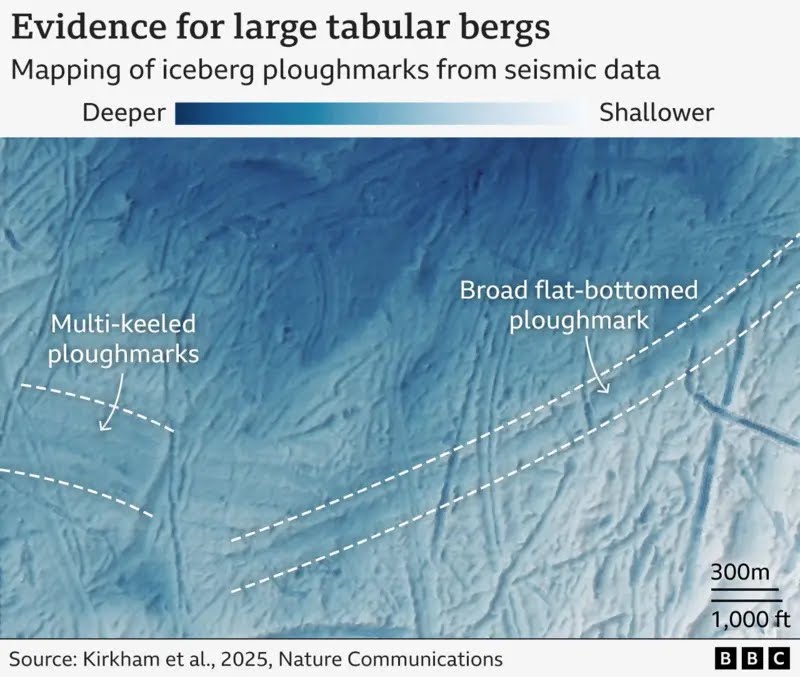
The study, published in Nature Communications, points to a sudden shift around 18,000 years ago when the production of giant icebergs abruptly ended. Instead, a greater number of smaller icebergs emerged, likely the result of ice shelf disintegration. This shift coincided with the rapid retreat of glaciers, raising a key question: did the collapse of ice shelves cause the glacier retreat, or were both symptoms of broader climate change?
Professor Eric Rignot, a glaciologist at the University of California, Irvine, noted that while the study reinforces the importance of ice shelves in stabilising ice sheets, the primary drivers of collapse remain warmer ocean and air temperatures.
Some of the ancient iceberg scars lie just 145 kilometres (90 miles) from Scotland’s east coast. The study opens new doors to understanding how ice sheets respond to warming, offering a long-term view that could help predict the future of Antarctica’s vulnerable ice shelves.
#ClimateChange #Antarctica #Icebergs #UKGeology #BritishIceSheet #SeaLevelRise #PaleoclimateResearch