Sri Lanka
 USA
USA Canada
 India
India UK
UK UAE
UAE




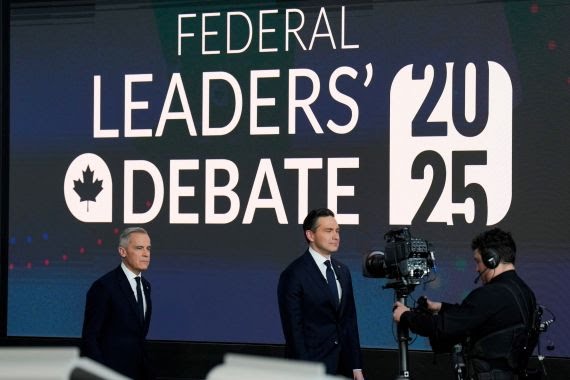
As Canada heads toward the April 28 election, party leaders clashed in a high-stakes debate dominated by growing US tensions and competing visions for the country’s economic and political future.
The leaders of Canada’s four main political parties—the Liberals, Conservatives, New Democratic Party (NDP), and Bloc Québécois—went head-to-head in a heated English-language debate ahead of the 2025 federal election.
Much of the conversation was shaped by escalating tensions with the United States. U.S. President Donald Trump’s aggressive trade policies and provocative remarks—most notably, a jesting threat to make Canada the “51st state”—have sparked a wave of nationalism that appears to be working in the Liberals’ favor.
Newly appointed Prime Minister Mark Carney, who took the reins from Justin Trudeau on March 14, highlighted his background as a former central banker. He argued that his expertise during periods of global financial instability positions him as the leader best equipped to protect Canada’s interests in the face of Trump’s economic aggression.
Conservative leader Pierre Poilievre also promised a strong stance against the U.S., but placed blame on the Liberals for a decade of what he described as economic stagnation. According to Poilievre, the country’s sluggish performance under Trudeau left it unprepared for international challenges.
Despite the verbal sparring, Carney appears to be gaining momentum. According to the CBC’s polling tracker, the Liberal Party currently leads with over 43% support, while the Conservatives trail at 38%. The NDP holds third place at 8.5%, followed by the Bloc Québécois at 5.7%.
As the election nears, all eyes remain on whether Carney can maintain his lead—and whether his pitch of economic stability will resonate more than Poilievre’s call for change.
#CanadaElection2025 #MarkCarney #PierrePoilievre #CanadianPolitics #ElectionDebate #CDNpoli #LiberalVsConservative #USCanadaRelations #April28Vote